As mentioned before, this will be a visual comparison between all the cultures (as apposed to the usual faiths within the cultures). Now an analysis of my final designs, in accordance to my final critical framework (Good and evil, in-game faiths, existing faiths, symbols, cliche, culture and fashion):
Just from looking, I realize throughout my development, my characters became more elaborate and interesting, and the Marisea, being the first culture I focused on, suffered because of this. Greater attention will be given to them when painting their final pieces.
I only added textures to the Acconians. I quite like this effect, and will spread it to the other two as well.
The fictional faith of Angelolgy was inspired by the Angels of Christianity. The faith focuses on detachment from the Earth and to try appease and become slaves of angels which live in the skies. The rules were inspired by several different existing faiths. All the Angelian's designs follow the rules of their faith while fitting in with their culture, many of which are symbols worn on them.
Cliches are visible but necessity. Of course a forest person will cover with foliage but the way it is presented is hoped to evoke high fashion sense. Stereotype was closely monitored in designing the Acconians; There are many desert-type people portrayed in video games. In the end, it was real life inspiration from Westernized and rich Middle-Eastern countries that use clothes practically that inspired the finished concept.
Finally, good and evil. These characters were designed as not to evoke a dislike or scared emotion but to encourage curiosity and interest for them. I believe this has mostly been a success from personal iteration and improvement on design, and feedback on visuals.
Showing posts with label Dissertation. Show all posts
Sunday, 21 April 2013
Gaian and Angelain Faiths and Culture comparision
Saturday, 20 April 2013
Angelo-Terrian final design & Terra-Feuille silhouettes
This marks the final designs for my characters, a total of 12! From these 12, I will be carrying on only 6, balanced genders and faiths, to paint in great detail to display for my final project piece and exhibition.
But first, the faith and silhouette comparisions of all the Terra-Fueille:
Next post I'll be a bit more precise with my comparisons and results of all my characters together.
But first, the faith and silhouette comparisions of all the Terra-Fueille:
Next post I'll be a bit more precise with my comparisons and results of all my characters together.
Thursday, 18 April 2013
Tuesday, 16 April 2013
Gaia-Terrian Final Design
Really happy with this direction, will get initial feedback from group meeting this Friday from mentor and friends. Made the crucial swap from vines to roots for the 'soul vine' (which will now be named a 'soul flower') and to make the flower itself blue so it stands out from the green and warm pink/reds/purples.
Tomorrows plan will be to begin incorporating the Angelolgy rules to create the Angelo-Terrians!
Wednesday, 10 April 2013
Acconian's final design
Angelo-Acconians! I'm done with my desert people for now, and will probaby carry on the Gaia-Acconian man and Angelo-Acconian female to work on top of for my final artifacts.
Below is a comparision with the two faiths, and their silhouettes. Very happy with the feathers in sihouette to distinguish them:
Onwards to the forest of Terra-Feuille!
Below is a comparision with the two faiths, and their silhouettes. Very happy with the feathers in sihouette to distinguish them:
Onwards to the forest of Terra-Feuille!
Monday, 8 April 2013
Final Design for Gaia-Acconian (2nd Iteration)
Many changes from the original posted last week, with my progress and reasons for this direction noted in the post before this one. Going to start tackling my forest people (Terra-Feuille) tomorrow.
Friday, 5 April 2013
Research and Iteration for Acconians
After today's meeting with Robin and team, it was affirmed I was falling into the 'stereotypes' pit. I'm struggling with this environment, simply cause there's already so many interpretations for desert/middle eastern designs, I need to portray; "practicality" "faith" "fashion" "environment" as well as all the critera set by the critical framework into the design.
So going back to research, this time focusing on how I can take something existing in the Middle East in a hot environment (specifically, Dubai (their fashion, their Islamic faith, their practicality and UAE rules are all very interesting and relevant)), sophistication incorporated into that design (suit/tie/formal wear, cleanliness, trim, etc), to incorporate the Gaian faith into this, and above all to create a good character design.
Research:
Incorporating these new findings into designs:
Moving away from the indigo coloured clothes, to tie in the environment, I've decided the motif and colours of a fantasy desert flower, based off of a real one:
The Gaia-Acconians will wear the flower like a symbol/sigil proudly, the colours too.
This experience is as expected an iterative process, and I hope to learn from my mistakes, document my progress and analysis the new design carefully so it meets the criteria posted above...This will all be documented in my Personal Project and Discussion chapters in my Dissertation.
Next post should show the new final Gaia-Acconian designs.
So going back to research, this time focusing on how I can take something existing in the Middle East in a hot environment (specifically, Dubai (their fashion, their Islamic faith, their practicality and UAE rules are all very interesting and relevant)), sophistication incorporated into that design (suit/tie/formal wear, cleanliness, trim, etc), to incorporate the Gaian faith into this, and above all to create a good character design.
Research:
Incorporating these new findings into designs:
Moving away from the indigo coloured clothes, to tie in the environment, I've decided the motif and colours of a fantasy desert flower, based off of a real one:
My interpretation:
The Gaia-Acconians will wear the flower like a symbol/sigil proudly, the colours too.
This experience is as expected an iterative process, and I hope to learn from my mistakes, document my progress and analysis the new design carefully so it meets the criteria posted above...This will all be documented in my Personal Project and Discussion chapters in my Dissertation.
Next post should show the new final Gaia-Acconian designs.
Wednesday, 3 April 2013
Angelo-Acconian sketches and Iterating Design
Sketchbook photos of my Angelo-Acconian design...:
But, I need to stop, take a step back and readdress these before I take them further. I'm falling into pits of stereotype. It might look cool, but it's not practical, and it's not a good link between design, faith, and the world surrounding them.
I'm going to go back, relook at Middle Eastern clothes, relook at materials of that sort of environment, and reiterate my original design. Next post will be an updated final design for my Acconians!
But, I need to stop, take a step back and readdress these before I take them further. I'm falling into pits of stereotype. It might look cool, but it's not practical, and it's not a good link between design, faith, and the world surrounding them.
I'm going to go back, relook at Middle Eastern clothes, relook at materials of that sort of environment, and reiterate my original design. Next post will be an updated final design for my Acconians!
Monday, 1 April 2013
Final Design for Gaia-Acconian
Here is my final design for my Acconian's of the Gaia faith...
Now that this is mostly set, I'm going to start incorporating and changing things to suit the Angelolgy faith, then compare the two designs side by side in completion and in silhouette form.
Sunday, 31 March 2013
High heels/shoes in the desert?
Finding it somewhat tricky at the moment to pin point which direction I want to go in for my Acconaians, but there are banks of inspirational things scattered in both the middle east and africa to still draw from. I'm just worried my doodles are looking too messy.
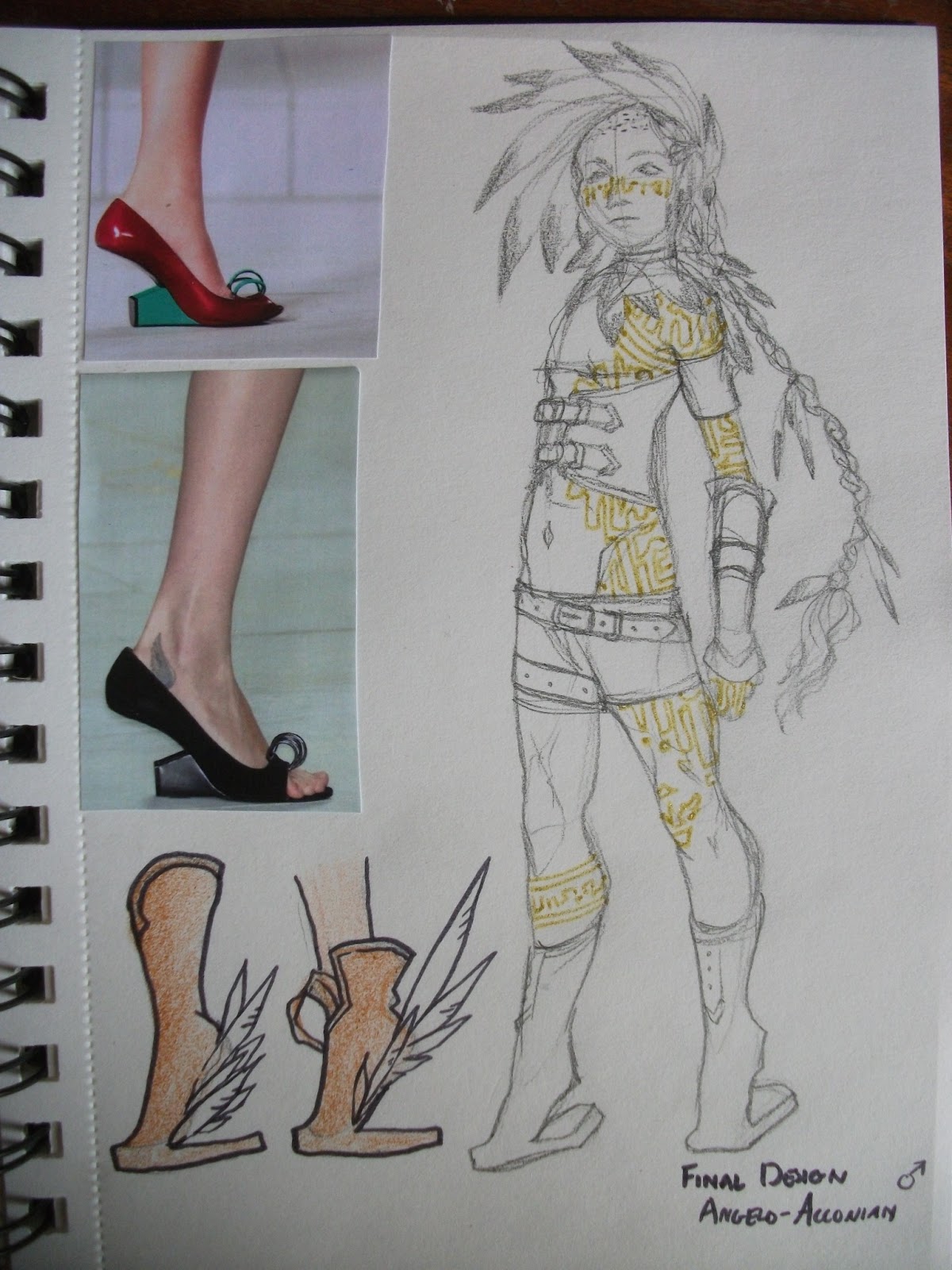
So for yesterday, I looked at mostly heels. I know I want my fantasy characters of the desert to be wearing unusual footwear, as apposed to sandals. I chose to incorporate a high heel for both genders to help keep feet off the scorching sand. I was told to make and break the rules of my own fantasy world so thats exactly what I want to do!
So most sandals worn in the desert will look like this:
But I really don't want to have such basic footwear on my characters, so I want to build on this!
I begun to research high heels and discovered they were originally used by men as a sign of power, masculinity and status (after evolving from their original purpose of riding (horses) shoes), which helped solidify my personal aim of trying to make sure male and females are the same in wear in the fantasy world being designed.
Various examples of unique heels, as well as a quick comparison in leg shape:
more...:
No doubt I'll be incorporating these moodboards into my next sketches.
Wednesday, 20 March 2013
Marisea Inhabitants Final Design 1.0
Here are both my Mermarian faiths side by side, to show how they differ. On top of this, I silhouetted them, to see how they compliment one another, both in static pose and underwater. My main concern is - in compliance with my critical framework - that:
- The characters do not look evil/good/threatening/menacing to the audience.
- The characters have the same roots, so they have to be similar, yet different. It's tricky to explain but...
- ...culture is to be separate from faith. So they share the same culture, but will outwardly express their faiths differently.
- Do they express well who they are? (faith, culture, attitude)
- Do they look stereotypical of existing cultures?
I will write up my report (analyzing my critical framework against my designs) after all 3 characters have been finalized. I am just documenting my progress in note form for myself the now.
I plan to get feedback on these characters Friday, but from here I'll be focusing now on the city of Acconagros.
Thursday, 14 March 2013
Gaia & Angelolian Faiths - Rules
While my fantasy faith "Angelolian" is down in basics, I've not explained the rules or indepth descriptions of my research. This post is mostly for me, it may be boring for fellow Comp Artists that follow me :)
While the dominant kind of faith in my world is inspired by pantheism, wildlife totemization and neopaganism, Angelolian is inspired by most organized religions. It's created as an alternative from worshiping Gaia/the earth. But all religion has rules.
At the core of Angelolian, is the belief of a higher being, in the form of winged beautiful human-like creatures called Angels. As with any organized religion, there is a central focus on a divinity by different names (God, Allah, etc) who is essentially the same being. In Angelology, there is no 'one' divinity, no hierarchy, but all angels are equally Holy. I've scrapped my own hierarchy I created. This is purely to cut my time as my project is not story based.
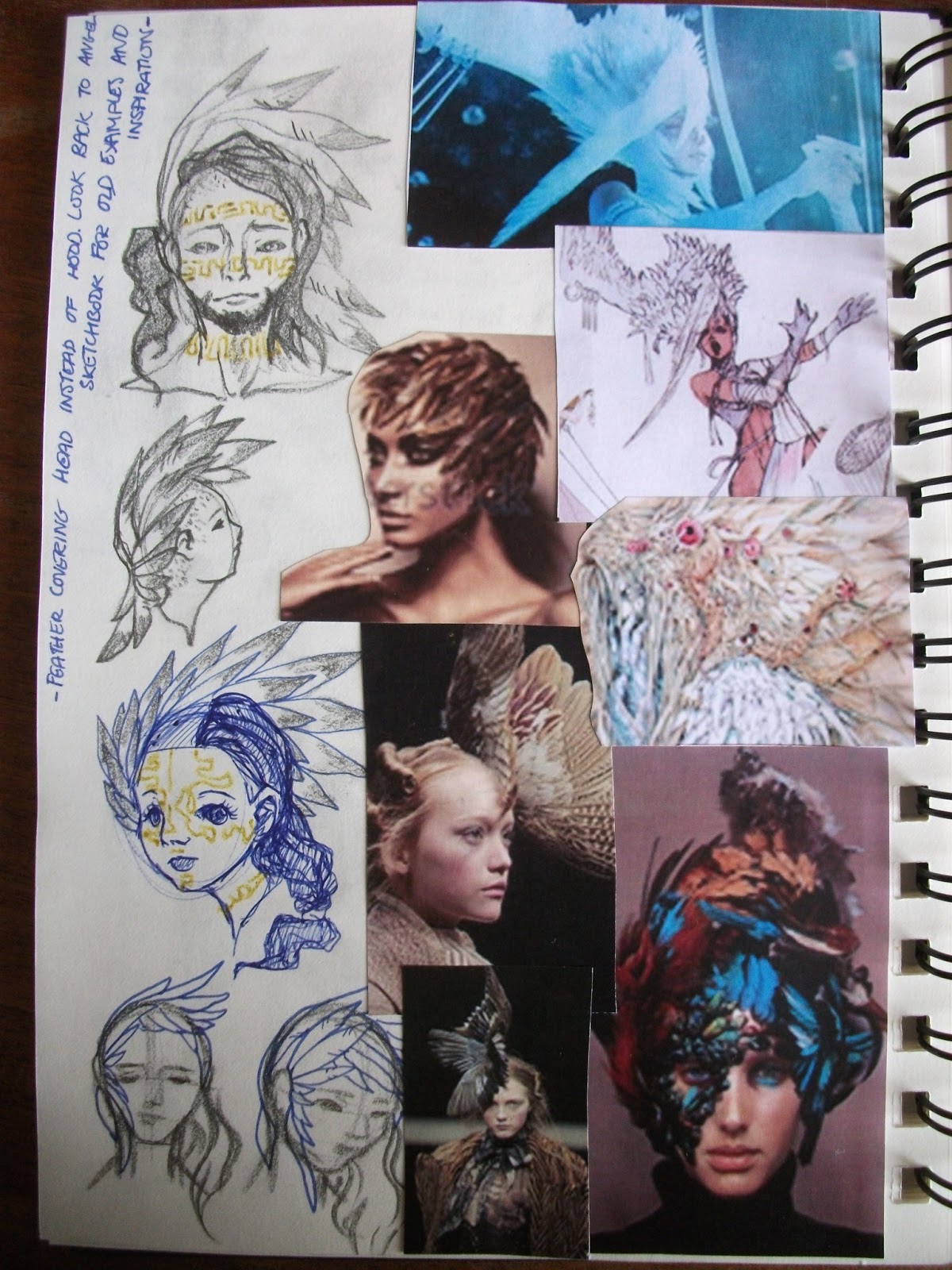
After a study into the different rules of hair in faith, I've decided this is a tricky one, what with every faiths variations. For instance, in the Christian and Islamic religions, it's frowned upon for men to have hair resembling a women's (length), while most women are discouraged from getting their hair cut, and Monks both male and female shave their hair for renunciation of worldly things (it's seen as vanity to maintain hair), to emulate a sense of slavery and poverty, and to follow in the steps of the Buddha, whom cut off his hair which symbolized royalty. And many faiths, encourage women to cover their hair. For my Angelology, there is NO differentiation between male and female rules (in hair, clothes, prayers, etc). I have drawn some pieces in my sketchbook already, but it is a sign of an Angelolian to shave parts of their hair off, but to leave some hair remaining. It is crucial for an Angelolian to embed feathers into their hair, and it is often this symbolism that will communicate their faith. The hair, and tattoos.
In India, it is often traditional in celebration to ink skin, nails, hair etc with Henna. Drawing inspiration from this, the symbols from angelolian scripts - said to be written by the Angels and left on Gaia for the people - are often written on the faces of Angelolians using Henna inks from plants.
Amulets; Many symbols are worn religiously, such as the Cross by Christians, and Islamic texts in Muska's. The Angelolgians follow something similar. The Nazar boncugu (also known as "the evil eye") is a well known symbol in bead form from Turkey, and is pinned on babies at birth, in businesses and home entrances and many people wear it as jewellery, in hopes of warding off evil or unwanted spirits and luck. Muska Tasimak is to write out a passage from the Qur'ran with personal wishes (I wish for my child to be healthy) and to fold this piece into a triangle, and to carry it in a triangular pendent. It's not uncommon to find Muska's with a Nazar boncuk. In a similar fashion, the Angelolians will be wearing a triangular amulet made from the natural elements of their environment.
Recap rules/beliefs of Angelology:
- Angels are divinity, they created the world and themselves.
- To shave off some hair is a sense of spirituality and affirms their slavery status to Angels.
- To place feathers in your hair will bless your mind with knowledge and wisdom from Angels.
- To write a prayer/Angelic symbols in Henna on skin is a physical sign of devotion.
- Wearing holy amulets in the shape of a triangle (containing prayers?) is a sign of devotion, and wards of evil spirits.
- Angeloligists must always cover their shoulder blades/back. It's seen as the Holiest part of the body. This is due to Angels wings sprout from shoulder blades, and they cover the embarrassment of not having these appendages.
Some references for my religious studies...:
http://www.dinimizislam.com/detay.asp?Aid=4797
http://www.nazarboncugu.com/Evil_Eye_History.htm
http://www.telegraph.co.uk/news/religion/7874274/Irans-Islamic-hair-catalogue-a-guide-to-religious-hairstyles.html
http://www.religiousforums.com/forum/buddhism-dir/54372-why-monks-bald.html
http://en.wikipedia.org/wiki/Tonsure
http://www.rupalpinto.com/mehndi/one.html
While the dominant kind of faith in my world is inspired by pantheism, wildlife totemization and neopaganism, Angelolian is inspired by most organized religions. It's created as an alternative from worshiping Gaia/the earth. But all religion has rules.
At the core of Angelolian, is the belief of a higher being, in the form of winged beautiful human-like creatures called Angels. As with any organized religion, there is a central focus on a divinity by different names (God, Allah, etc) who is essentially the same being. In Angelology, there is no 'one' divinity, no hierarchy, but all angels are equally Holy. I've scrapped my own hierarchy I created. This is purely to cut my time as my project is not story based.
After a study into the different rules of hair in faith, I've decided this is a tricky one, what with every faiths variations. For instance, in the Christian and Islamic religions, it's frowned upon for men to have hair resembling a women's (length), while most women are discouraged from getting their hair cut, and Monks both male and female shave their hair for renunciation of worldly things (it's seen as vanity to maintain hair), to emulate a sense of slavery and poverty, and to follow in the steps of the Buddha, whom cut off his hair which symbolized royalty. And many faiths, encourage women to cover their hair. For my Angelology, there is NO differentiation between male and female rules (in hair, clothes, prayers, etc). I have drawn some pieces in my sketchbook already, but it is a sign of an Angelolian to shave parts of their hair off, but to leave some hair remaining. It is crucial for an Angelolian to embed feathers into their hair, and it is often this symbolism that will communicate their faith. The hair, and tattoos.
In India, it is often traditional in celebration to ink skin, nails, hair etc with Henna. Drawing inspiration from this, the symbols from angelolian scripts - said to be written by the Angels and left on Gaia for the people - are often written on the faces of Angelolians using Henna inks from plants.
Amulets; Many symbols are worn religiously, such as the Cross by Christians, and Islamic texts in Muska's. The Angelolgians follow something similar. The Nazar boncugu (also known as "the evil eye") is a well known symbol in bead form from Turkey, and is pinned on babies at birth, in businesses and home entrances and many people wear it as jewellery, in hopes of warding off evil or unwanted spirits and luck. Muska Tasimak is to write out a passage from the Qur'ran with personal wishes (I wish for my child to be healthy) and to fold this piece into a triangle, and to carry it in a triangular pendent. It's not uncommon to find Muska's with a Nazar boncuk. In a similar fashion, the Angelolians will be wearing a triangular amulet made from the natural elements of their environment.
Recap rules/beliefs of Angelology:
- Angels are divinity, they created the world and themselves.
- To shave off some hair is a sense of spirituality and affirms their slavery status to Angels.
- To place feathers in your hair will bless your mind with knowledge and wisdom from Angels.
- To write a prayer/Angelic symbols in Henna on skin is a physical sign of devotion.
- Wearing holy amulets in the shape of a triangle (containing prayers?) is a sign of devotion, and wards of evil spirits.
- Angeloligists must always cover their shoulder blades/back. It's seen as the Holiest part of the body. This is due to Angels wings sprout from shoulder blades, and they cover the embarrassment of not having these appendages.
Some references for my religious studies...:
http://www.dinimizislam.com/detay.asp?Aid=4797
http://www.nazarboncugu.com/Evil_Eye_History.htm
http://www.telegraph.co.uk/news/religion/7874274/Irans-Islamic-hair-catalogue-a-guide-to-religious-hairstyles.html
http://www.religiousforums.com/forum/buddhism-dir/54372-why-monks-bald.html
http://en.wikipedia.org/wiki/Tonsure
http://www.rupalpinto.com/mehndi/one.html
Monday, 11 March 2013
Indepth Marisea Town
Following my last post with sketches of Mermarians, I got prompted by fellow Computer Artist Robin with some questions I really didn't have answers too. "How do they dye their clothes?" "Where did they get the wetsuits from?" "Colour scheme; Are there predators?" And the fact that I was so stumped showed how weak my current concepts are.
Following our conversation, I turned to my notes from my mentor meeting last week with Robin Sloan, and he had told me to begin researching secular, cultural anthropology, and tribes. From here, I realized I had made a mistake with my current concepts; they were based off of existing fantasy media, rather than influenced by real life close-enough scenarios.
Today, I researched areas of religion/faith which worships the land. I narrowed the broad area down to Pantheism, Wildlife Totemization and Neopaganism. I also believe deeper Cultural and Social Anthropology studies will benefit me greatly when discussing my project in my dissertation.
Here are ares I've looked at today for my Mermarians. There will be many many more days of research into existing tribal and secluded cultures to see how things work:
And I can now answer those questions, Robin G! Sea silk! :)
Following our conversation, I turned to my notes from my mentor meeting last week with Robin Sloan, and he had told me to begin researching secular, cultural anthropology, and tribes. From here, I realized I had made a mistake with my current concepts; they were based off of existing fantasy media, rather than influenced by real life close-enough scenarios.
Today, I researched areas of religion/faith which worships the land. I narrowed the broad area down to Pantheism, Wildlife Totemization and Neopaganism. I also believe deeper Cultural and Social Anthropology studies will benefit me greatly when discussing my project in my dissertation.
Here are ares I've looked at today for my Mermarians. There will be many many more days of research into existing tribal and secluded cultures to see how things work:
And I can now answer those questions, Robin G! Sea silk! :)
Sunday, 10 March 2013
My fantasy towns and faiths names...
A post to clear up confusing language I use. I say culture and faith often, but need to give them names so I can better communicate what I mean sometimes... :)
Seaside - Marisea Town
Resident is called a Mermarian. Religious individual called Angelo-Mermarian.
Desert - Acconagros City
Resident is called an Acconian. Religious individual called Angelo-Acconian.
Forest - Terra-Feuille Village
Resident is called a Feuillian. Religious indivdual called Angelo-Feuillian.
The Religion - Angelolity - Worship of the angels, to believe they are higher beings who created and govern the world they live on. Faithful are called Angelolian.
I will probably iterate this post often.
Seaside - Marisea Town
Resident is called a Mermarian. Religious individual called Angelo-Mermarian.
Desert - Acconagros City
Resident is called an Acconian. Religious individual called Angelo-Acconian.
Forest - Terra-Feuille Village
Resident is called a Feuillian. Religious indivdual called Angelo-Feuillian.
The Religion - Angelolity - Worship of the angels, to believe they are higher beings who created and govern the world they live on. Faithful are called Angelolian.
I will probably iterate this post often.
Thursday, 7 March 2013
Environment and Culture: Mood boards
As seen from my last update, I've been looking at clothes and faith, but feel like my sketches are going no where, and are story-less. And they sort of are. So this blog post is dedicated to some research into the kinds of environments my faithful characters will be living and worshiping in...
I want to showcase 6 different characters for my final project. 3 different environments, that encompass 2 different faithful groups in one culture. e.g. One faithful group will worship the Angels, while the other, the land/environment they live on. I will be focusing on Forest, Dessert and Ocean environments.
Forest Moodboard:
Ocean Moodboard:
As I was compiling these mood boards and looking into towns/cities, I decided to keep forestry (over a village), ocean to a seaside (at first I was thinking remote island, now I'm thinking seaside/beach/fishing town) and a desert city with some water source and interesting building shapes with a new colour palette.
Next: Practice-based research/development/sketching & Colour Palette
I want to showcase 6 different characters for my final project. 3 different environments, that encompass 2 different faithful groups in one culture. e.g. One faithful group will worship the Angels, while the other, the land/environment they live on. I will be focusing on Forest, Dessert and Ocean environments.
Forest Moodboard:
Desert Moodboard:
Ocean Moodboard:
As I was compiling these mood boards and looking into towns/cities, I decided to keep forestry (over a village), ocean to a seaside (at first I was thinking remote island, now I'm thinking seaside/beach/fishing town) and a desert city with some water source and interesting building shapes with a new colour palette.
Next: Practice-based research/development/sketching & Colour Palette
Friday, 1 March 2013
Final Case Study: Ni no Kuni
Humans in different geographic's in Ni no Kuni: Wrath of the White Witch
Ni no Kuni - Wrath of the White Witch (first released in Japan 2011) follows the tale of Oliver, a resident of Motorville, who loses his mother after she dies saving him. Oliver's sad tears bring his soft toy to life, a gift from his mother, and the toy reveals himself to be Mr.Drippy, a fairy from the Another World. With the guidance of Drippy, Oliver travels into the Other World, becomes a practicing wizard and journeys the new land in hopes of finding his parallel world mother, and meets several friends (both new and parallel to his world) along the way.
"Another World" - Oliver's first encounter
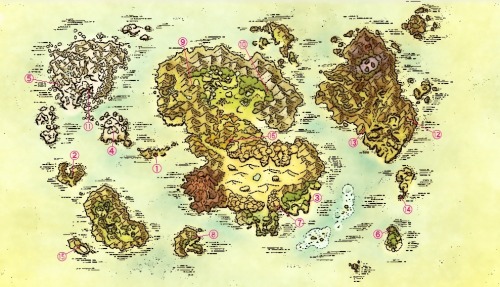
The world of Ni no Kuni (lit. "Another World") is beautifully crafted and contains many natural beautiful locations varying from forestry, volcanoes, oceans, islands to deserts. Many of these areas are populated by humans and varied local species, and have their own cultures and monarchy/government. None of the areas seem to be negatively engaged in relations (this could be due to a powerful evil that lurks and threatens them, rather than neighbours going to war), and it's interesting to see humans in different fantasy environments adapt to their surroundings.
World Map
The various geographics are home to species other than humans, but for this case study the center of focus will be on humans. Visually, those from Ding Dong Dell vary greatly from those in Al Mamoon, as well as the city of Hamlin. The inhabitants of Al Mamoon live in bright and abundant dessert lands, full of Islamic, Persian and Mughal architecture, and the inhabitants often have their hair and body covered in colourful cloths. It's easy to see the fantastical cartoon spin inspired by the middle east. The citizens of Ding Dong Dell wear medieval-style garments, and the city is a warm setting of luscious greens and nature, with European and Ottoman-Empire style architecture. And finally the contrast with Hamelin; a city of industrial and steel, it's a dark environment lit with warm lights. The inhabitants are human, but wear armour in the shape of pigs at the order of the Prince. Hamlin in comparison is initially much colder, hostile, and uninviting than the other cities, but the townspeople are just as kind. As part of this study, a link between the visuals and the judgement of good or bad is crucial, and Hamelin is a key example of how visual design can be misinterpreted. The warm welcoming glow of Hamelin's night lights expel some negativity and becomes inviting.
Towns of Ni no Kuni: Al Mamoon - Ding Dong Dell - Hamelin
There are clear tones of a pure good and a pure bad when the game first begins, but with most Studio Ghibli films, there's no such thing. The game instead has a deep connection to Aristotle's view of Virtue Ethics. It follows the formula of 'balance'. For example, with too much of a virtue e.g courage, a person can become rash, but with too little become timid. So in this sense, good/bad is the spiritual core of the game.
Oliver's locket stores different virtues, which he takes using the spell "Take Heart"
Ni no Kuni's recent release in the West has inspired online debates about it's originality. As a JRPG, it's subjected to be compared to a very stale genre, but this case study focus' on the visual style presented. Again it's a debatable issue, for example the world map while gorgeous, has mimiced Tales of Vesperia and Dragon Quest VIII. It is however, ultimately captivating with beautiful much-loved Studio Ghibi stylization and designs.
Results as compared to Critical Framework:
Subscribe to:
Posts (Atom)